| Gemstone Chart |
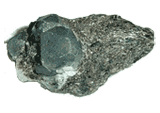 Natural Alexandrite Natural Alexandrite
Alexandrite was discovered in 1830 in the Ural mountains of Russia. Alexandrite is also found in Sri Lanka, Brazil, India, Tanzania, Zimbabwe, and most recently in Madagascar. The alexandrite variety of chrysoberyl is one of the rarest and most sought after of all gems.
Color: changing from green to red
Categories: semi-precious stone
Chemical Composition: BeAl2O4
Crystal Group: Orthorhombic
Refractive Index: 1.741 - 1.760
Hardness: 8.50
Density: 3.73
Occurrence: Tanzania, India, Russia, Madagascar, Sri Lanka, Zimbabwe, Zambia
| 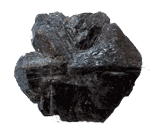 Natural Chrysoberyl Natural Chrysoberyl
The Chrysoberyl family is best known for the more valuable alexandrite and catseye varieties. Faceted chrysoberyl is a beautiful gem which is not as well known in its own right. Apart from the high hardness, it takes a good polish and has a good luster.
Color: yellow, green, color changing, red, blue-green, greenish-yellow or brown
Categories: semi-precious stone
Chemical Composition: BeAl2O4
Crystal Group: Orthorhombic
Refractive Index: 1.741 - 1.760
Hardness: 8.5
Density: 3.73
Occurrence: Ceylon, Tanzania, Russia, Madagascar, Brazil.
| 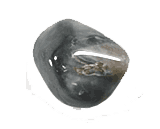 Natural Chrysoberyl Cats Eye Natural Chrysoberyl Cats Eye
Chrysoberyl cats eye is a very rare and expensive gemstone which is found in small quantities in Sri-Lanka and Brazil. The cats eye is present because the stone has chatoyancy in its make up and this effect cause the ‘eye’ which moves as the gem is gently turned .
Color: yellow, greenish yellow, yellowish green
Categories: semi-precious stone
Chemical Composition: BeAl2O4
Crystal Group: Orthorhombic
Refractive Index: 1.741 - 1.760
Hardness: 8.5
Density: 3.73
Occurrence: Ceylon, Tanzania, Russia, Madagascar, Brazil.
| 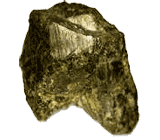 Natural Enstatite Natural Enstatite
Enstatite is a relatively common mineral, but is rarely used for jewelry purposes. It is generally cut for gem connoisseurs and collectors rather than for the common consumer.
Color: Gray, green, brown, orange-brown, yellowish-brown, colorless, pale yellow.
Categories: semi-precious stone
Chemical Composition: MgSiO3
Crystal Group: Orthorhombic
Refractive Index: 1.663-1.673
Hardness: 5.5
Density: 3.26-3.28
Occurrence: South Africa, Burma, Tanzania, Sri Lanka, Kenya, Germany, Norway, Greenland
| 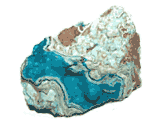 Natural Hemimorphite Natural Hemimorphite
Hemimorphite is a usually white or colorless mineral, essentially Zn4Si2O7(OH)2·H2O, an important ore of zinc. Also called calamine.
Color: Light blue, dark blue, green ,white.
Categories: semi-precious stone
Chemical Composition: (Zn4Si2O7(OH)2.H2O)
Crystal Group: Orthorhombic
Refractive Index: 1.612-1.633
Hardness: 5
Density: 3.44
Occurrence: Franklin and Sterling Hill New Jersey, New Mexico, Montana, Arizona, U.S.A; Congo; Nerchinak in Transbaikalia, Siberia; Zambia; Santa Eulalia and Mapimi, Mexico; England; Wenshan, Yunnan Province, China.
| 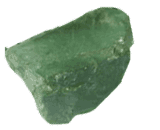 Natural Kornerupine Natural Kornerupine
Kornerupine is a rare mineral occasionally used as a gemstone. It appears frequently in parcels from Ceylon and may be confused with beryl, peridot, topaz, or quartz.
Color: Brown, brownish red, yellow-green, light green, blue green
Categories: semi-precious stone
Crystal Group: Orthorhombic
Refractive Index: 1.665 – 1.683
Hardness: 6.5
Density: 3.25 - 3.35
Occurrence: Ceylon, Tanzania
| 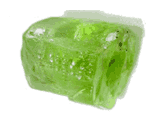 Natural Peridot Natural Peridot
Peridot is the best known gem variety of olivine, a species name for a series of magnesium-iron rich silicate minerals.It is one of the prettiest of all green gems.Most peridot formed deep inside the earth and was brought to the surface by volcanoes. Some has also come to Earth in meteorites, but this extraterrestrial peridot is extremely rare, and you're not likely to see it in a retail jewelry store.
Color: Green, olive.
Categories: semi-precious stone
Chemical Composition: (Mg,Fe)2(SiO)4
Crystal Group: Orthorhombic
Refractive Index: 1.654-1.689
Hardness: 6.5
Density: 3.34
Occurrence: China, Burma, East Africa, U.S.A., and Vietnam
| 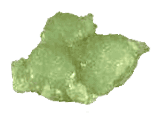 Natural Prehnite Natural Prehnite
Prehnite is a hydrated calcium aluminum silicate that occurs in a soft yellow-green to apple-green color.It was a rare gemstone, most prehnite is translucent but transparent specimens are sometimes found.While you are unlikely to find it in your local jewelry store, gemstone dealers often have some supply. Deposits are found in South Africa, Australia, China, Scotland and the United States.
Color: yellow green, brown, yellow brown, oil green
Categories: semi-precious stone
Chemical Composition: (CA2Al2SI3O10(OH)2)
Crystal Group: Orthorhombic
Refractive Index: 1.61 - 1.64
Hardness: 6
Density: 2.80 - 2.95
Occurrence: China, France, U.S.A., Scotland, Australia
|
|

 |Register|Sign in|Customization



+'/&media=https://www.etoolsage.com/../images/eTools.gif'+'&description='+encodeURIComponent(document.title),'_blank','toolbar=yes, location=yes, directories=no, status=no, menubar=yes, scrollbars=yes, resizable=no, copyhistory=yes, width=600, height=450,top=100,left=350');void(0) "Pinterest")


