| Gemstone Chart |
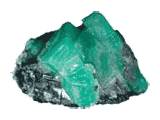 Natural Emerald Natural Emerald
Emerald, the green variety of the mineral beryl, is the most famous and favored green gemstone.The majority of the worlds gem quality Emeralds come from the Muzo area of Colombia.
Color: Blue, Green Blue
Categories: precious stone
Chemical Composition: Be3Al2(SiO3)6
Crystal Group: Hexagonal
Refractive Index: 1.577(+-.016), 1.583 (+-.017)
Hardness: 7.5-8
Density: 2.72 (-.05, +.12)
Occurrence: Brazil, Pakistan,Russia, East Africa, India, Madagascar, Columbia
| 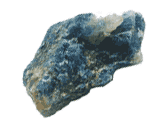 Natural Euclase Natural Euclase
Euclase is a rare mineral, resembling beryl in color and hardness.Euclase is found in granitic pegmatites with other gem minerals such as topaz and beryl.
Color: White, pale blue, greenish blue, dark blue.
Categories: semi-precious stone
Chemical Composition: BeAlSiO4(OH)
Crystal Group: Monoclinic
Refractive Index: 1.652-1.672
Hardness: 7.5
Density: 3.18
Occurrence: Brazil, Tanzania, Russia, Zimbabwe, Madagascar, Austria.
| 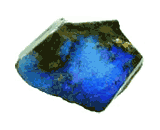 Natural Opal Natural Opal
Opal is the most colorful of all gems. It is a form of silica chemically similar to quartz, but more like glass and containing a variable amount of water within the mineral structure. Its splendid play of color is unsurpassed, and fine examples can be more valuable than diamond. Precious opals (black and white) are cut and polished into cabochons and used in all forms of jewelry.
Color: White, green, blue, black, red, orange, violet, pink, grey, yellow.
Categories: precious stone
Chemical Composition: SIO2nH2O
Crystal Group: Amorphous
Refractive Index: 1.44-1.46
Hardness: 5.5 - 6.0
Density: 2.65 - 3.00
Occurrence: Czechoslovakia, Mexico, Honduras, Australia, Brazil, Tanzania.
| 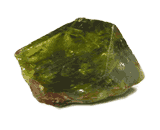 Natural Sphene Natural Sphene
Sphene is also known as calcium titanium silicate.It is named from the greek word for wedge, because of its typical wedge shaped crystal habit.Because of it's high dispersion and refractive index, a well cut sphene can display stunning brilliance. Sphene is somewhat soft and as a result is more suitable as a pendant than as a ring stone. Sphene is rarely very clean.
Color: Green, yellow. brown
Categories: semi-precious stone
Chemical Composition: CaTiSiO5
Crystal Group: Monoclinic
Refractive Index: (1.885-1.990,)-(1.915-2.050)
Hardness: 5.5
Density: 3.52-3.54
Occurrence: Austria, Dheirene-Madagascar, India, USA, Brazil.
| 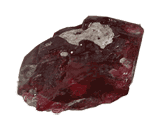 Natural Spinel Natural Spinel
Spinel is the magnesium aluminium member of the larger spinel group of minerals. It has the formula MgAl2O4.Pure spinel is white, but impurities give it a wide range of colors.Almost all colors are used in jewelry, but the most valuable and popular color is the deep red. Spinel is cut into gems for use as jewelry. The deep-red variety, known as ruby spinel, is the most prized form.
Color: orange, pink, black, blue, lavender, mauve, greenish blue, and vivid red
Categories: semi-precious stone
Chemical Composition: MgAl2O4
Crystal Group: Cubic
Refractive Index: 1.718 (-.006,+.044)
Hardness: 8
Density: 3.60 (-.03, +.30)
Occurrence: Mogok, Burma; Sri Lanka; Amboseli district, Kenya; Jemaa district, Nigeria; Matombo, Umba, and Tunduru Tanzania; Hunza, Pakistan; Pamir range, Tajikstan; Luc Yen, Vietnam; Madagascar; Australia; Sweden; Brazil.
| 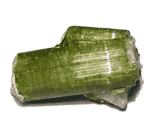 Natural Tourmaline Natural Tourmaline
Tourmaline is actually a group of several different minerals which have similar crystal structures, but complex and variable chemical formulas. Tourmaline is the most varicolored of all gemstones. It occurs in all colors, but red, green, and multicolored are its most famous gem colors.
Color: blue, bluish green, green, greenish blue, green-blue or blue-green, greenish yellow, orangy red, red, red-orange or orange-red, red-purple or purple-red, slightly purplish red, slightly yellowish green, strongly purplish red, strongly yellowish green, very slightly bluish green, yellowish green, yellow-green or green-yellow, colorless, brown, pink
Categories: semi-precious stone
Chemical Composition: (NaCa)(LI,MgFe,Al)9B3Si6(O,OH)31
Crystal Group: Hexagonal
Refractive Index: 1.624(+.005, -.005) - 1.644(+.006, -.006)
Hardness: 7-7.5
Density: 3.06 (.05, +.15)
Occurrence: Brazil, East Africa, Nigeria, Madagascar, U.S.A.
|
|

 |Register|Sign in|Customization



+'/&media=https://www.etoolsage.com/../images/eTools.gif'+'&description='+encodeURIComponent(document.title),'_blank','toolbar=yes, location=yes, directories=no, status=no, menubar=yes, scrollbars=yes, resizable=no, copyhistory=yes, width=600, height=450,top=100,left=350');void(0) "Pinterest")


