| Gemstone Chart |
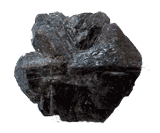 Natural Chrysoberyl Natural Chrysoberyl
The Chrysoberyl family is best known for the more valuable alexandrite and catseye varieties. Faceted chrysoberyl is a beautiful gem which is not as well known in its own right. Apart from the high hardness, it takes a good polish and has a good luster.
Color: yellow, green, color changing, red, blue-green, greenish-yellow or brown
Categories: semi-precious stone
Chemical Composition: BeAl2O4
Crystal Group: Orthorhombic
Refractive Index: 1.741 - 1.760
Hardness: 8.5
Density: 3.73
Occurrence: Ceylon, Tanzania, Russia, Madagascar, Brazil.
| 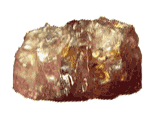 Natural Color Change Sapphire Natural Color Change Sapphire
A rare variety of sapphire, known as color changing sapphire, exhibits different colors in different light. A color change sapphire is blue in natural light, and violet in artificial light. A similar effect is also seen in alexandrite.
Color: Color changing blue to purple, greenish brown to red
Categories: semi-precious stone
Chemical Composition: AL22O3
Crystal Group: Hexagonal
Refractive Index: 1.759-1.778
Hardness: 9
Density: 4
Occurrence: Ceylon, East Africa
| 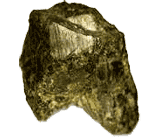 Natural Enstatite Natural Enstatite
Enstatite is a relatively common mineral, but is rarely used for jewelry purposes. It is generally cut for gem connoisseurs and collectors rather than for the common consumer.
Color: Gray, green, brown, orange-brown, yellowish-brown, colorless, pale yellow.
Categories: semi-precious stone
Chemical Composition: MgSiO3
Crystal Group: Orthorhombic
Refractive Index: 1.663-1.673
Hardness: 5.5
Density: 3.26-3.28
Occurrence: South Africa, Burma, Tanzania, Sri Lanka, Kenya, Germany, Norway, Greenland
| 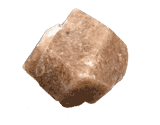 Natural Grossularite Natural Grossularite
A member of the garnet group, grossularite is found in a variety of colors including, yellow, brown, white, colorless, green, violet-red, and orangey red.
Color: Brown, yellow, green
Categories: semi-precious stone
Chemical Composition: Ca3Al2(SiO4)3
Crystal Group: Cubic
Refractive Index: 1.72-1.748
Hardness: 7.25
Density: 3.65
Occurrence: Canada, East Africa, Pakistan, New Zealand, Ceylon, South Africa, U.S.A.
| 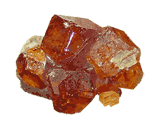 Natural Hessonite Natural Hessonite
Hessonite is one of the gem varieties of the garnet mineral, grossular. Hessonite is usually cinnamon brown and has been called "cinnamon stone". Hessonite can also be orange; this color is becoming common on the gem markets.
Color: Brownish-orange, brownish yellow, aurora red
Categories: semi-precious stone
Chemical Composition: Ca3Al2(SIO4)3
Crystal Group: Cubic
Refractive Index: 1.72-1.74
Hardness: 7.25
Density: 3.65
Occurrence: Sri Lanka, Mexico, Brazil, Canada, Madagascar
| 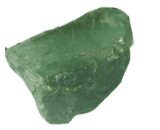 Natural Kornerupine Natural Kornerupine
Kornerupine is a rare mineral occasionally used as a gemstone. It appears frequently in parcels from Ceylon and may be confused with beryl, peridot, topaz, or quartz.
Color: Brown, brownish red, yellow-green, light green, blue green
Categories: semi-precious stone
Crystal Group: Orthorhombic
Refractive Index: 1.665 ¨C 1.683
Hardness: 6.5
Density: 3.25 - 3.35
Occurrence: Ceylon, Tanzania
| 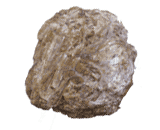 Natural Sillimanite Natural Sillimanite
Sillimanite is an alumino-silicate mineral with the chemical formula Al2SiO5. Sillimanite is a very rare trimorph and it has a common variety called fibrolite.
Color: violet blue, grey green, colorless, brown, green,
Categories: semi-precious stone
Chemical Composition: Al2OSiO4
Crystal Group: Orthorhombic
Refractive Index: 1.658 - 1.678
Hardness: 6 - 7.5
Density: 3.25
Occurrence: France, Madagascar, U.S.A., Sri Lanka, Burma. Kenya
| 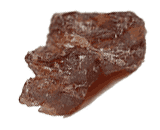 Natural Spessartite Natural Spessartite
The Spessartite is one of the most popular of all garnets. It is highly desired by collectors, jewelry designers and gem lovers.The sources for gem quality spessartine are Sri Lanka and Brazil.
Color: Orange, yellow, brown
Categories: semi-precious stone
Chemical Composition: Mn3Al2(SiO4)3
Crystal Group: Cubic
Refractive Index: 1.79-1.81
Hardness: 7.25
Density: 4.14-4.20
Occurrence: Germany, Ceylon, Burma, Nigeria, Maevatanana-Madagascar, Isoanala-Madagascar, East Africa.
|
|

 |Register|Sign in|Customization



+'/&media=https://www.etoolsage.com/../images/eTools.gif'+'&description='+encodeURIComponent(document.title),'_blank','toolbar=yes, location=yes, directories=no, status=no, menubar=yes, scrollbars=yes, resizable=no, copyhistory=yes, width=600, height=450,top=100,left=350');void(0) "Pinterest")


