| Gemstone Chart |
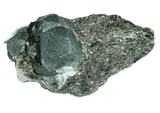 Natural Alexandrite Natural Alexandrite
Alexandrite was discovered in 1830 in the Ural mountains of Russia. Alexandrite is also found in Sri Lanka, Brazil, India, Tanzania, Zimbabwe, and most recently in Madagascar. The alexandrite variety of chrysoberyl is one of the rarest and most sought after of all gems.
Color: changing from green to red
Categories: semi-precious stone
Chemical Composition: BeAl2O4
Crystal Group: Orthorhombic
Refractive Index: 1.741 - 1.760
Hardness: 8.50
Density: 3.73
Occurrence: Tanzania, India, Russia, Madagascar, Sri Lanka, Zimbabwe, Zambia
| 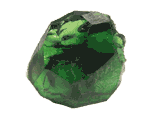 Natural Chrome Tourmaline Natural Chrome Tourmaline
Chrome tourmaline is a beautiful bottle-green variety of the gemstone. Gem-quality chrome tourmaline is quite pricey and is found in East Africa.
Color: dark green, light green, yellowish green
Categories: semi-precious stone
Chemical Composition: (NaCa)(LI,MgFe,Al)9B3Si6(O,OH)31
Crystal Group: Hexagonal
Refractive Index: 1.624(+.005, -.005) - 1.644(+.006, -.006)
Hardness: 7-7.5
Density: 3.06 (.05, +.15)
Occurrence: East Africa
| 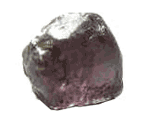 Natural Color Change Garnet Natural Color Change Garnet
Color Change Garnet is one of the most rare, interesting, and phenomenal of all gems.Color Change Garnet gem stone rough from Madagascar Gems is fine quality.
Color: Color changing from green or lavender to red.
Categories: semi-precious stone
Crystal Group: Cubic
Refractive Index: Nesosilicate
Hardness: 7-7.5
Density: 3.8
Occurrence: East Africa, Madagascar, Sri Lanka
| 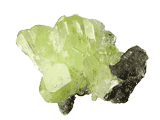 Natural Diopside Natural Diopside
Diopside is a common mineral and is found worldwide. Diopside has several varieties, including a chromium-rich gem variety called chrome diopside.
Color: pale bluish green or dark blue green, brownish green or dark blue green. yellowish green or yellow bluish green.
Categories: semi-precious stone
Chemical Composition: CaMgSi2O6
Crystal Group: Monoclinic
Refractive Index: 1.665 - 1.730
Hardness: 6
Density: 3.25 - 3.55
| 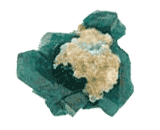 Natural Dioptase Natural Dioptase
Dioptase is an intense emerald-green to bluish-green copper cyclosilicate mineral.Dioptase is a rather unusual gemstone that will rarely be found in your basic jewelry stores. It is a beautiful gemstone with a very unusual combination of green colors.
Color: Dark blue green, emerald green, or turquoise
Categories: semi-precious stone
Chemical Composition: CuSiO2(OH) 2
Crystal Group: Hexagonal
Refractive Index: RI 1.644 ¨C 1.709
Hardness: 5
Density: 3.28 ¨C 3.55
Occurrence: Russia, Tsumeb Namibia, California and Colorado USA, Congo, Zaire, Chile
| 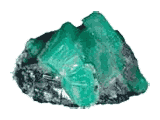 Natural Emerald Natural Emerald
Emerald, the green variety of the mineral beryl, is the most famous and favored green gemstone.The majority of the worlds gem quality Emeralds come from the Muzo area of Colombia.
Color: Blue, Green Blue
Categories: precious stone
Chemical Composition: Be3Al2(SiO3)6
Crystal Group: Hexagonal
Refractive Index: 1.577(+-.016), 1.583 (+-.017)
Hardness: 7.5-8
Density: 2.72 (-.05, +.12)
Occurrence: Brazil, Pakistan,Russia, East Africa, India, Madagascar, Columbia
| 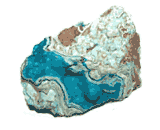 Natural Hemimorphite Natural Hemimorphite
Hemimorphite is a usually white or colorless mineral, essentially Zn4Si2O7(OH)2¡¤H2O, an important ore of zinc. Also called calamine.
Color: Light blue, dark blue, green ,white.
Categories: semi-precious stone
Chemical Composition: (Zn4Si2O7(OH)2.H2O)
Crystal Group: Orthorhombic
Refractive Index: 1.612-1.633
Hardness: 5
Density: 3.44
Occurrence: Franklin and Sterling Hill New Jersey, New Mexico, Montana, Arizona, U.S.A; Congo; Nerchinak in Transbaikalia, Siberia; Zambia; Santa Eulalia and Mapimi, Mexico; England; Wenshan, Yunnan Province, China.
| 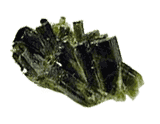 Natural Idocrase Natural Idocrase
Primarily a green color that will resemble jade.idocrase is one stone that is sometimes mistaken for jade by jewelers and consumers alike. Idocrase is from the greek and means mixed form, an allusion to its crystals showing a mixture of other mineral forms.
Color: normally green, but also can be brown, yellow, blue and/or purple.
Categories: semi-precious stone
Chemical Composition: nesosilicate or sorosilicate
Crystal Group: Tetragonal
Refractive Index: 1.71 - 1.73
Hardness: 6.5
Density: 3.3 - 3.5
Occurrence: Quebec, Canada; California and the New England region of USA; Mt Vesuvius, Italy; Ural Mountains, Russia, Switzerland, East Africa
|
|

 |Register|Sign in|Customization



+'/&media=https://www.etoolsage.com/../images/eTools.gif'+'&description='+encodeURIComponent(document.title),'_blank','toolbar=yes, location=yes, directories=no, status=no, menubar=yes, scrollbars=yes, resizable=no, copyhistory=yes, width=600, height=450,top=100,left=350');void(0) "Pinterest")


